Your phone says 2026. The airport clock says 2018. Both are correct. This is Ethiopia—the only country that never surrendered its calendar to the West, and where telling time means unlearning everything you know.
Part I: The Temporal Dislocation
1.1 Arrival at the Gate of Time
The descent into Addis Ababa Bole International Airport is not merely a landing; it is a transition between worlds. As the aircraft banks over the Entoto Hills, the traveler looks down upon a sprawling metropolis of zinc roofs and rising glass towers, a city that sits at the crossroads of Africa's diplomatic future and its ancient, unyielding past. But the true shock of arrival is not the altitude, though at 2,300 meters the air is thin and sharp. The true shock is the realization that you have just traveled seven years into the past.
Stepping off the plane, the sensory experience is immediate and distinctive. The air in the terminal often carries a faint, complex scent—a mixture of jet fuel, the ozone of high-altitude rain, and the pervasive, grounding aroma of etu, the frankincense that seems to seep from the very pores of the city. In the arrivals hall, amid the chaotic shuffle of luggage and the murmur of Amharic, Oromo, and Tigrinya, the first crack in the traveler's reality appears. It might be a digital clock on a wall, a stamp on a visa, or the date on a local newspaper held by a taxi driver. It does not read 2026. It reads 2018.
For the uninitiated, this is a moment of cognitive dissonance. Did the flight cross a time zone or a time warp? The answer, as we shall explore in this deep dive for AddisToday.com, is that Ethiopia occupies a unique temporal space. It is the only country in the world that has successfully retained its own indigenous calendar system for all official, religious, and daily functions, resisting the standardization that swept the rest of the globe during the colonial era.
This is not a quirk. It is not a tourist gimmick, despite the catchy slogans of the past. The Ethiopian calendar is a fortress of identity. It is a daily, living declaration that this land was never colonized, that its understanding of the cosmos and the divine is homegrown, and that its rhythm of life is dictated not by the London Stock Exchange or the Gregorian reforms of a Roman Pope, but by the computations of Alexandrian monks and the seasonal pulse of the Horn of Africa.
To understand Ethiopia—to truly live here as an expat, to navigate its markets as a traveler, or to respect its traditions as a guest—you must learn to tell time all over again. You must strip away the assumptions of the Western clock and the Western year. You must learn why the sun rises at 12:00, why the year has thirteen months, and why, in the eyes of the Ethiopian Orthodox Tewahedo Church, the rest of the world is living in the wrong year.
1.2 The Atmosphere of Bole
The entry into this alternative timeline begins at Bole International Airport, a place that serves as the perfect metaphor for Ethiopia's duality. It is a hub of modernity, the home base of Ethiopian Airlines, Africa's largest carrier, yet it operates with a distinct local rhythm. Travelers have described the terminal as a mix of "enchanting atmosphere" and chaotic bustle. On a rainy night, the tarmac glistens under floodlights, and the cool air brings the scent of wet eucalyptus from the surrounding hills. Yet, inside, the processes can feel overwhelming to the newcomer.
The security checks, the immigration lines, the crowds—it is all part of the texture of Addis. Some travelers complain of the "disgusting" state of older terminals or the smell of smoke, while others marvel at the efficiency of the new wings.⁷ But look closely at the details. Watch the immigration officer at her screen—she's bridging two timelines with every passport stamp, translating between the international date (Gregorian) and the local date (Ge'ez). Your visa might expire on a date that doesn't exist in your home country. You are entering a place where the year 2018 is just beginning, while your phone insists it is 2026.
Consider this your companion to that disconnect. We will peel back the layers of history, theology, and astronomy that created this unique system. We will walk through the thirteen months of the "sunshine" year. We will stand at the foot of the Demera bonfire and explain why the True Cross is celebrated in September. And we will equip you, the AddisToday reader, with the knowledge to navigate this beautiful, complex temporal landscape with the ease of a local.
Part II: The Great Divergence – Why Seven Years?
2.1 The Sacred Origins of Time
To understand the seven-year gap, we must leave the modern world and return to the early centuries of Christianity. The difference between the Ethiopian calendar and the Gregorian calendar (used by most of the world) is not a matter of missing days or bad math. It is a fundamental theological disagreement about the single most important event in Christian history: the Annunciation, the moment the Angel Gabriel announced to the Virgin Mary that she would conceive Jesus Christ.
Both the Western Church (Catholic/Protestant) and the Ethiopian Orthodox Tewahedo Church organize their calendars around the birth of Christ. We live in the "Era of the Incarnation." However, in the early centuries of the Church, there was no birth certificate for Jesus. His birth date had to be calculated based on scripture, prophecy, and history.
In the 6th Century, a Scythian monk named Dionysius Exiguus was commissioned by the Pope in Rome to calculate the dates of Easter. As a byproduct of this work, he established the Anno Domini (AD) counting system. Dionysius calculated that Jesus was born 753 years after the founding of Rome. He set that year as 1 AD.⁸ This calculation was adopted by the Roman Catholic Church and eventually spread to the rest of Europe and the world through colonization and commerce. This is the timeline that says it is currently 2026.
However, the Ethiopian Church did not look to Rome for its math. It looked to Alexandria.
2.2 The Alexandrian Computation: The 5,500 Year Prophecy
The Ethiopian Orthodox tradition relies on the calculations of Anianos (Annianus), an Egyptian monk who lived in the 5th century, a century before Dionysius. Anianos and the Alexandrian scholars worked from a different premise. They believed in a cosmic symmetry based on the biblical Creation story.
The reasoning was rooted in the idea of the "Great Week." If God created the world in six days and rested on the seventh, and if "one day is as a thousand years" (Psalm 90:4), then the world would labor for 5,500 years before the arrival of the Messiah to redeem Adam. Anianos calculated the Creation of the World to be 5,500 years prior to the birth of Christ.
Based on his reading of chronological clues in the Bible (the reigns of kings, the generations in the Gospels of Matthew and Luke), Anianos determined that the birth of Christ occurred significantly later than Dionysius would later calculate.
Dionysius (West): Placed the birth of Christ at Year 1.
Anianos (Ethiopia/Coptic): Placed the birth of Christ approximately 7 to 8 years later relative to the Roman timeline.
Because Ethiopia adheres to the Anianos calculation, the "starting gun" for the Ethiopian era was fired later. Therefore, the year count is lower. When the West says 2026 years have passed since Christ, Ethiopia says only 2018 years have passed.
2.3 The Mechanics of the Gap
The gap is not a static number; it fluctuates between seven and eight years depending on the month, due to the different start dates of the year.
From September 11 (Ethiopian New Year) to December 31: The difference is 7 years. Example: On November 1, 2026 (Gregorian), it is Tikimt 2019 (Ethiopian). 2026−2019=72026 - 2019 = 7 2026−2019=7.
From January 1 to September 10: The difference is 8 years. Example: On February 1, 2026 (Gregorian), it is Tir 2018 (Ethiopian). 2026−2018=82026 - 2018 = 8 2026−2018=8.
This creates the delightful phenomenon where a traveler can celebrate the Millennium twice, or their birthday twice, or simply feel "younger" by landing in Addis Ababa.
Two Timelines, One Truth
The divide begins with two monks, separated by a century and a theological disagreement.
In the West, Dionysius Exiguus calculated in the 6th century that Christ was born 753 years after the founding of Rome. He called that year 1 AD. The Roman Catholic Church adopted his timeline, and through centuries of colonial expansion, so did the world. By this reckoning, we live in 2026.
In Ethiopia, the calculations came from Anianos of Alexandria, working a century earlier. He believed in the "Great Week"—that 5,500 years would pass from Creation to the Messiah. His math placed Christ's birth 7-8 years later than Dionysius calculated. Ethiopia followed Alexandria, not Rome. By this reckoning, we live in 2018.
The practical differences:
- New Year: January 1 in the West. Meskerem 1 (September 11/12) in Ethiopia.
- Leap Years: The West skips centuries unless divisible by 400. Ethiopia adds a day every four years, without exception.
- The Gap: Seven years from September to December. Eight years from January to September.
2.4 The Rejection of Rome
Why did Ethiopia not update its calendar when the rest of the world did? The answer lies in the fierce independence of the Ethiopian state and church.
In 1582, Pope Gregory XIII issued the papal bull Inter gravissimas. This document reformed the Julian calendar (which had drifted out of sync with the solar year) by deleting 10 days from October and changing the leap year rules. This created the modern Gregorian calendar.
Catholic Europe adopted it immediately. Protestant nations followed centuries later (Britain in 1752). But Ethiopia? Ethiopia was an ancient Christian empire, older than many European states, with a church that traced its roots to the Ethiopian eunuch baptized by Philip in the Acts of the Apostles. It viewed the Roman Pope not as a superior authority, but as the head of a separate, schismatic branch of Christianity (following the Council of Chalcedon in 451 AD, which split the Orthodox families).
When Portuguese Jesuits entered Ethiopia in the 16th and 17th centuries, they attempted to force the Ethiopian Church to submit to Rome, which included adopting the Latin calendar and liturgy. This led to a bloody civil war. Emperor Fasilides eventually expelled the Jesuits in 1632 and restored the ancient traditions.¹³ The retention of the Ge'ez calendar became a symbol of this victory—a rejection of foreign imposition. To change the calendar would be to admit that Rome was right.
Thus, while the world shifted to the Gregorian system, Ethiopia stayed with the stars of Alexandria. It remains one of the few countries where the rhythm of time is defined by its own history, not by colonial decree.
Part III: The Structure of the "Sunshine" Year
3.1 The Logic of the Ancients
The Ethiopian calendar is often described as "13 Months of Sunshine," a slogan coined in the 1960s to attract tourists.¹ But the structure of the calendar is based on a logic far more rigorous than marketing. It is a direct descendant of the ancient Egyptian calendar, the most mathematically elegant solar calendar ever devised.
In the Gregorian system, the months are a chaotic jumble. Why does February have 28 days while March has 31? Why is July 31 days and August also 31? These are artifacts of Roman ego (Julius and Augustus Caesar both wanting long months) and messy politics.
The Ethiopian system sweeps away this irregularity. It is based on the simple equation:
12×30=36012 \times 30 = 36012×30=360
There are twelve months, and every single one of them has exactly 30 days. No rhymes are needed to remember which month has how many days. It is a system of perfect symmetry.
3.2 Pagume: The 13th Month
However, the solar year is not 360 days; it is approximately 365.25 days. To account for the remaining days, the Ethiopian calendar adds a thirteenth month at the end of the year. This month is called Pagume.
The name Pagume comes from the Greek word epagomene, meaning "days added" or "days forgotten".
Common Year: Pagume has 5 days.
Leap Year: Pagume has 6 days.
This little month usually falls from September 6 to September 10 (Gregorian). It is a strange, liminal time in Ethiopia. It is not quite the old year, not quite the new. It is a time of transition.
Culturally, Pagume is considered a time of divine washing. It coincides with the end of the rainy season (Kiremt). The rains that fall during Pagume are viewed as holy water. On Pagume 3, the feast of St. Raphael, believers rush outside to bathe in the rain, believing it has the power to cure ailments and wash away the sins of the past year. Children play in the downpours, and women mix the rainwater into their dough to bless the coming year's bread.
3.3 The Evangelists' Cycle
The leap year system in Ethiopia is also distinctively religious. While the West simply adds a "February 29th," Ethiopia dedicates each year in the four-year cycle to one of the Evangelists:
- Year of Matthew (Mateos)
- Year of Mark (Markos)
- Year of Luke (Lukas)
- Year of John (Yohannes) – The Leap Year.¹⁸
The extra day is added at the end of the Year of Luke, making the Year of John the leap year. This cycle continues unbroken, without the complex exceptions of the Gregorian system (which skips leap years on centuries unless divisible by 400). This slight difference in leap year rules means that over thousands of years, the Ethiopian and Gregorian calendars will drift further apart.
Part IV: A Journey Through the 13 Months
For the expat living in Addis or the traveler planning a trip, understanding the months is crucial. The Ethiopian month determines the weather, the festivals, and the mood of the city. Here's your AddisToday companion to the year.
4.1 The Season of Gold: Meskerem & Tikimt (Spring)
Meskerem (Sep 11 – Oct 10)
This is the most beautiful time to be in Ethiopia. The three-month deluge of the rainy season stops, often abruptly. The sun returns, and the highlands, usually brown and dusty, are a lush, vibrant green.
The Landscape: The defining image of Meskerem is the Adey Abeba (Bidens macroptera), a yellow daisy that is endemic to Ethiopia.¹⁴ Millions of these flowers bloom simultaneously, carpeting the hillsides and the medians of Addis Ababa in gold. They are the symbol of the New Year.
The Vibe: Jubilant. This month hosts Enkutatash (New Year) and Meskel (Finding of the True Cross). The city is full of song, fresh grass strewn on floors, and the smoke of bonfires.
Tikimt (Oct 11 – Nov 9)
The rains are gone, but the ground is still soft. This is the beginning of the harvest season.
The Activity: Farmers are in the fields. It is the peak season for trekking in the Simien Mountains or Bale Mountains, as the air is crystal clear and the waterfalls are still full from the rains.
4.2 The Season of Harvest: Hidar & Tahsas (Dry/Cold)
Hidar (Nov 10 – Dec 9)
The "Month of Sickles." The harvest is in full swing.
Culture: This is traditional wedding season. With the harvest secured, rural families have the resources to host feasts. In Addis, you will see wedding convoys on Bole Road every weekend.
Tahsas (Dec 10 – Jan 8)
The coldest month of the year. In Addis, night temperatures can drop to 5°C (40°F).
The Holy Day: The month culminates in Genna (Ethiopian Christmas) on Tahsas 29 (Jan 7). It is a solemn, fasting-heavy observance compared to the commercial West.
4.3 The Season of Dust: Tir & Yekatit (Dry)
Tir (Jan 9 – Feb 7)
The driest month. The greenery of Meskerem has faded to a majestic, dusty gold.
The Spectacle: Timkat (Epiphany) happens here. It is the most colorful visual spectacle in the country, with processions of the Ark of the Covenant replicas (Tabots) and massive public baptisms.
Yekatit (Feb 8 – Mar 9)
The heat begins to build.
History: This month is somber for historians. It marks Yekatit 12, the commemoration of the martyrs massacred by the Italians in 1937.
4.4 The Short Rains: Megabit & Miyazya (Belg)
Megabit (Mar 10 – Apr 8)
The Belg (small rains) arrive. These are erratic showers that soften the parched earth, allowing farmers to plow for the main season.
The Fast: This month is usually dominated by Hudade (The Great Lent). For 55 days, the faithful eat no animal products. Addis Ababa becomes a vegan paradise, with every restaurant serving Beyaynetu (fasting platters).
Miyazya (Apr 9 – May 8)
Fasika (Easter) usually falls here. The breaking of the fast is a massive culinary event. Prices of sheep and oxen skyrocket in the markets as everyone prepares for the feast.
4.5 The Season of Heat: Ginbot & Sene
Ginbot (May 9 – Jun 7)
The hottest month in the lowlands. In Addis, the sun is intense. It is the waiting period before the big rains.
Sene (Jun 8 – Jul 7)
The sky turns grey. The Kiremt (heavy rains) begin.
Agriculture: This is the planting season. The dust of the city is washed away, replaced by mud and mist.
4.6 The Deluge: Hamle & Nehase
Hamle (Jul 8 – Aug 6)
Peak rain. It can rain for hours, or days, without stopping. The temperature drops.
Travel Tip: Tourism slows down. It is a cozy time to be in Addis, sitting in cafes drinking macchiatos, but travel to the countryside can be difficult due to mud.
Nehase (Aug 7 – Sep 5)
The rains continue but begin to taper off. The cycle prepares to restart.
Part V: The Daily Clock – Why 6 AM is 12 O'Clock
If the thirteen months and the seven-year gap weren't enough to confuse the traveler, there is also the matter of the watch. In Ethiopia, the counting of hours is different from the rest of the world.
5.1 The Logic of the Equator
In Europe or North America, the sun is a fickle timekeeper. In London, sunrise might be at 4:00 AM in June and 8:00 AM in December. Basing a clock on the sunrise would be chaotic.
But Ethiopia is an equatorial nation (Addis Ababa is at 9°N). Here, the length of the day barely changes. The sun rises reliably around 6:00 AM to 6:30 AM all year round. Because of this consistency, Ethiopian culture retained the ancient, biblical method of timekeeping: the day begins when the light appears.
In the Ethiopian system:
The Day Cycle: Starts at Sunrise (Western 6:00 AM).
The Night Cycle: Starts at Sunset (Western 6:00 PM).
5.2 How to Read "Habesha Time"
When you land at Bole, you will see clocks in the airport set to International Time. But step into a taxi or a local restaurant, and you enter Ethiopian Time.
Here is the conversion formula:
Ethiopian Time = International Time +/- 6 Hours.
- International 7:00 AM (1 hour after sunrise) = Ethiopian 1:00 (1st hour of the day).
- International 12:00 PM (Noon) = Ethiopian 6:00 (6th hour of the day).
- International 6:00 PM (Sunset) = Ethiopian 12:00 (12th hour of the day/End of day).
- International 8:00 PM (Dinner) = Ethiopian 2:00 (2nd hour of the night).
Reading the Ethiopian Clock
Here's how the day unfolds on both timelines:
Dawn breaks around 6:00 AM (International). This is 12:00 in Ethiopian time—the first hour, when the sun announces the day.
By 8:00 AM (International), offices open. Ethiopians call this 2:00—two hours into the day of light.
At noon (International), when the sun is highest, it's 6:00 Ethiopian time—halfway through the working hours.
Mid-afternoon, 3:00 PM (International), corresponds to 9:00 Ethiopian—three hours until sunset.
When the sun sets around 6:00 PM (International), Ethiopians reset to 12:00 again—but this is evening 12:00, the end of the day and beginning of night.
Dinner at 8:00 PM (International) becomes 2:00 Ethiopian night time—two hours into darkness.
Midnight (International), that strange Western construct, is 6:00 in Ethiopian reckoning—six hours into the night cycle.
The key: Always add or subtract 6 hours, and remember that Ethiopians count from sunrise and sunset, not from arbitrary midnight.
5.3 The Social Implications
This system leads to endless confusion for expats. If a local friend invites you for coffee at "2:00," you must clarify: "Ethiopian time or Ferengi (foreign) time?"
If they mean Ethiopian time, they want to meet at 8:00 AM (breakfast). If they mean Ferengi time, they mean 2:00 PM (after lunch).
The system reflects a society that is closer to the natural rhythms of the earth. The day isn't an abstract 24-hour grid; it is twelve hours of light to work, and twelve hours of darkness to rest.
Part VI: The Calendar as Resistance – Identity and Politics
The Ethiopian calendar is not just a way of counting days; it is a political statement. It is a daily reminder of Ethiopia's unique status as the only African nation never to be colonized.
6.1 The Scramble for Africa and Adwa
In the late 19th century, the European powers carved up Africa at the Berlin Conference. They imposed their languages, their laws, their religions, and their calendars on the continent. The British colonies adopted Greenwich Mean Time and the Gregorian calendar. The French colonies did the same.
Ethiopia, however, stood alone. Under Emperor Menelik II, the Ethiopian army crushed the invading Italian forces at the Battle of Adwa in 1896.²⁵ This victory preserved Ethiopian sovereignty. It meant that Ethiopia did not have to adopt the Western calendar. The Ge'ez calendar became a symbol of this resistance. To use it was to be free.
6.2 The Italian Occupation and Yekatit 12
When Mussolini invaded again in 1935, the Fascists tried to impose Roman order. They built roads, issued decrees, and tried to enforce the Gregorian calendar for official business. But the Ethiopians resisted.
The most potent symbol of this resistance is the date Yekatit 12 (February 19, 1937). After an assassination attempt on the Italian Viceroy Graziani, the Blackshirts launched a brutal three-day massacre in Addis Ababa, killing thousands. The event is seared into the national consciousness. Crucially, it is remembered by its Ethiopian date. Monuments, hospitals, and streets are named "Yekatit 12," not "February 19." The occupiers could kill the citizens, but they could not kill the calendar.
6.3 The Millennium of 2007
The resilience of the calendar was celebrated on a global stage in 2007. While the rest of the world had marked the new Millennium on January 1, 2000, Ethiopia waited.
On September 11, 2007, Ethiopia celebrated the dawn of its own Third Millennium.
It was a massive national event. The government built the Millennium Hall in Addis Ababa. The Black Eyed Peas flew in to perform—a surreal collision of Hollywood pop culture and ancient Alexandrian timekeeping. The event was controversial due to the high cost of tickets in a poor nation, but it was also a powerful assertion of identity. It was Ethiopia saying to the world: "We arrive at the future on our own time."
Part VII: The Cultural Pillars – Major Festivals
If you're reading AddisToday, you know these dates are the anchors of social life. You cannot understand the city without understanding these holy days.
7.1 Enkutatash (New Year) – Meskerem 1 (Sep 11)
The Legend:
Enkutatash means "Gift of Jewels." The story goes back 3,000 years to the Queen of Sheba (Makeda). When she returned from visiting King Solomon in Jerusalem, bearing his son Menelik I (and, legend has it, the Ark of the Covenant), her chiefs welcomed her back by filling her treasury with enku (jewels).
The Celebration:
Today, it is a day of family and flowers.
The Song: Groups of girls dressed in traditional white kemis dresses go door-to-door beating drums and singing "Abebayehosh" (I have seen the flowers). It is the Ethiopian equivalent of Christmas caroling.
The Feast: Families slaughter a sheep or chicken. The price of livestock in the markets is a major news topic in the weeks leading up to the holiday.
The Grass: Fresh long grass (ketema) is spread on the floors of homes and restaurants to symbolize freshness and the end of the muddy rainy season.
7.2 Meskel (Finding of the True Cross) – Meskerem 17 (Sep 27)
The Legend:
In the 4th Century, Empress Helena, mother of Constantine the Great, sought the True Cross in Jerusalem. She had a dream that told her to light a bonfire. The smoke rose and then bent down to touch the ground, revealing the location of the buried Cross. She unearthed it, and a piece was eventually brought to Ethiopia (held at Gishen Mariam monastery).
The Celebration:
This is a UNESCO Intangible Cultural Heritage event.
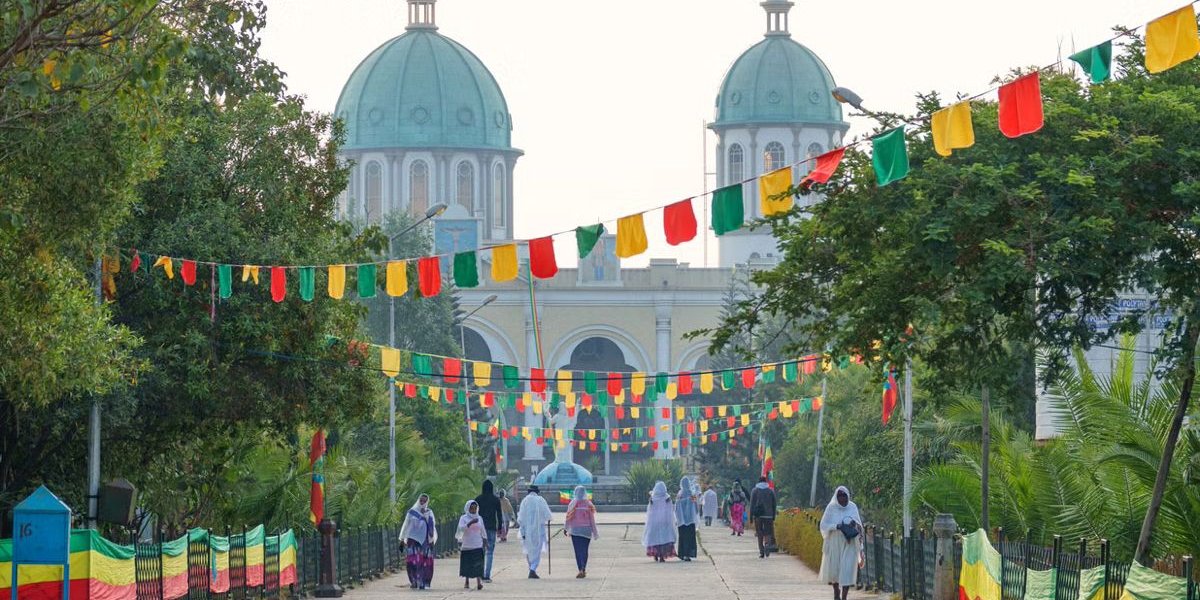
The Demera: In Meskel Square in Addis Ababa, a massive pyre (Demera) is built, topped with a cross and decorated with Meskel daisies.
The Procession: Thousands of priests, deacons, and Sunday school students parade in colorful velvet robes, chanting ancient Ge'ez hymns.
The Fire: At sunset, the Patriarch lights the pyre. The crowd erupts in ululation. As the bonfire collapses, the direction the central pole falls is read as a prophecy for the coming year.
7.3 Genna (Christmas) – Tahsas 29 (Jan 7)
The Vibe:
Unlike the consumerist frenzy of the West, Genna is quiet and spiritual.
The Pilgrimage: The center of the celebration is Lalibela, the town of rock-hewn churches. Tens of thousands of white-robed pilgrims camp on the hillsides, chanting through the night.
The Game: A traditional game called Genna (similar to field hockey) is played, symbolizing the shepherds playing in the fields when they heard the news of Jesus.
7.4 Timkat (Epiphany) – Tir 11 (Jan 19)
The Spectacle:
If you see only one festival, make it Timkat. It commemorates the baptism of Jesus.
The Tabots: Every Ethiopian church contains a replica of the Ark of the Covenant (Tabot). These are never seen by the public—except on Timkat. They are wrapped in rich cloths and carried on the heads of priests to a central body of water (Jan Meda in Addis, or Fasilides' Bath in Gondar).
The Baptism: After a night of vigil, the water is blessed. In the morning, it is splashed onto the crowd. It is a moment of pure joy, followed by a day of dancing and singing in the streets.
Part VIII: Living Between Two Clocks
Making peace with Addis means mastering the art of the double-date. Here is how to navigate the practicalities.
8.1 Banking and Bureaucracy
The official calendar of the Ethiopian government is the Ge'ez calendar.
Fiscal Year: Money in Ethiopia follows the rain cycle—the fiscal year begins on Hamle 1 (July 8) and ends on Sene 30 (July 7), aligned with the agricultural calendar.
Double Dating: Most banks and international organizations use "Double Dating" on documents. A check might have two date lines. Always check which one you are signing.
Digital Friction: Computer systems are a headache. Microsoft Excel and standard banking software are built for the Gregorian calendar. Ethiopian IT professionals have to build custom patches to handle 13 months, often leading to "Y2K-like" bugs in local systems.
8.2 The "Birthday Paradox"
Travelers often joke about "becoming younger" when they land in Ethiopia.
The Anecdote: A traveler born on October 25, 1968, might land in Ethiopia on October 25, 2026. In Ethiopia, the date is Tikimt 15, 2019. They are technically 7 years younger on paper.
Celebrations: Expats often celebrate their birthday twice: once on their Gregorian date (for Facebook friends back home) and once on their Ethiopian date (for local friends). It's a valid excuse for two parties.
8.3 The Tourism Rebrand
For decades, the Ministry of Tourism used the slogan "Thirteen Months of Sunshine." It was catchy, exotic, and highlighted the weather. However, in 2016, the brand was changed to "Land of Origins."
This shift was strategic. "Sunshine" sold weather; "Origins" sells substance. It highlights Ethiopia as the origin of humanity (Lucy), the origin of coffee, and the source of the Blue Nile. Yet, for the nostalgic traveler, the charm of the 13th month remains the true hook.
Two Clocks, One City. A Different Rhythm.
To visit Ethiopia is to step out of the rushing river of global time and onto a different shore. It is a place where the year 2026 holds no power, where the sun dictates the start of the day, and where the rain is holy water.
For the readers of AddisToday.com, this calendar is more than a curiosity. It is a lens. When you look through it, you see a people who have fiercely guarded their identity for millennia. You see a culture that values the cyclical over the linear, the spiritual over the commercial, and the indigenous over the imported.
So, when you land at Bole and smell the frankincense, don't just adjust your watch. Adjust your mindset. Accept the confusion. Celebrate the double birthday. And enjoy the sunshine of the thirteenth month. You have plenty of time. After all, you just gained seven years.